
Main Articles
GENIUS: an agentic AI framework for autonomous design and execution of simulation protocols
Published on: 09/05/2026
Participants: Mohammad Soleymanibrojeni, Roland Aydin, Diego Guedes-Sobrinho, Alexandre C. Dias, Maurício J. Piotrowski, Wolfgang Wenzel & Celso Ricardo Caldeira Rêgo
Abstract:
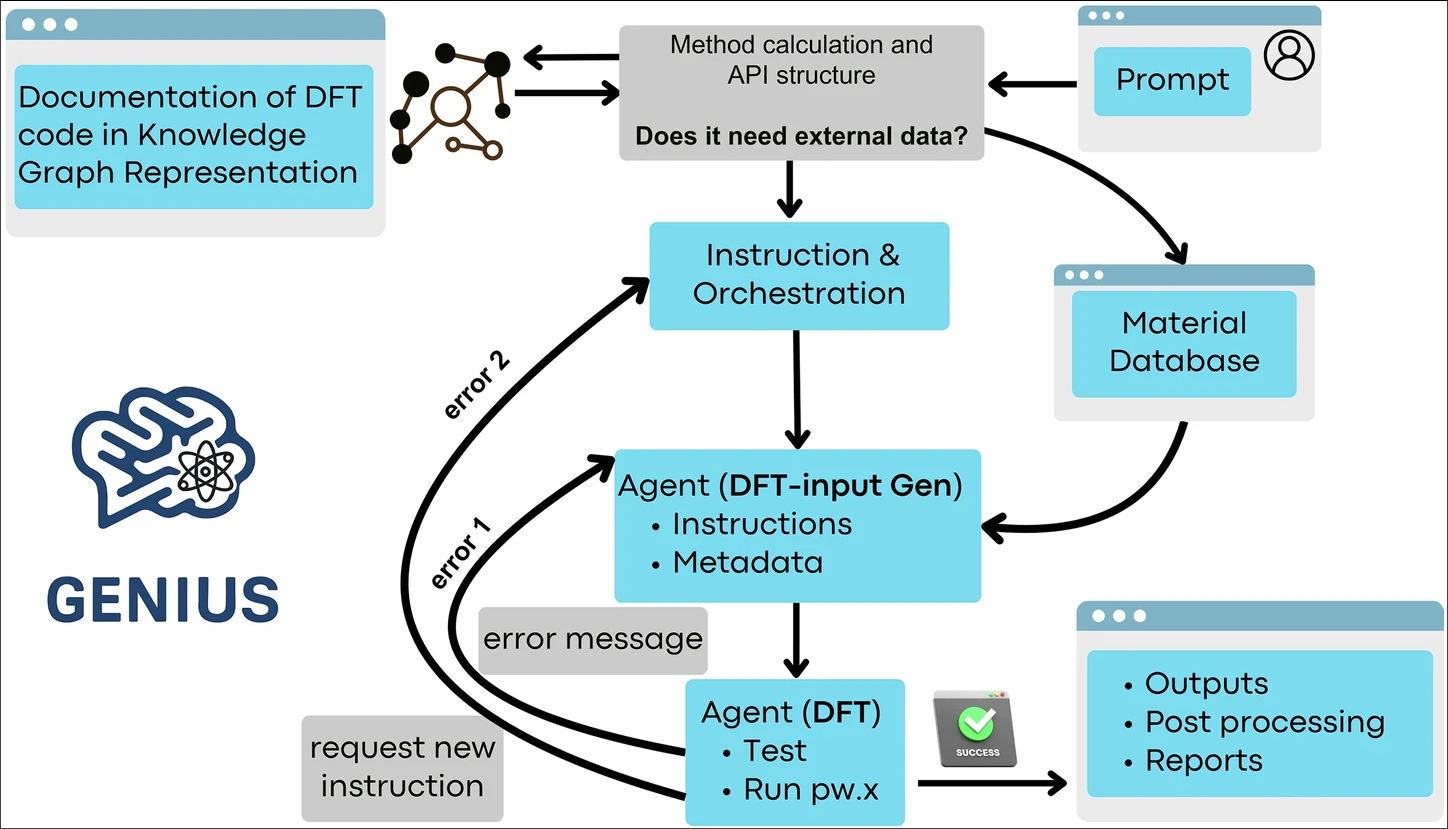
Predictive atomistic simulations have propelled materials discovery, yet routine setup and debugging still demand computer specialists. This know-how gap limits the use of Integrated Computational Materials Engineering (ICME), where state-of-the-art codes exist but remain cumbersome for non-experts. We address this bottleneck with GENIUS, an AI-agentic workflow that fuses a smart Quantum ESPRESSO knowledge graph with a tiered hierarchy of large language models supervised by a finite-state error-recovery machine. Here we show that GENIUS translates free-form human-generated prompts into Quantum ESPRESSO input files that pass early execution validation for ≈ 80% of 295 diverse benchmarks. Zero-shot generation succeeds for 14.2% of all prompts, and among cases that do not succeed initially, 76.3% are autonomously recovered by the automated error-handling loop, with the attempt-wise success rate decaying exponentially toward a 7% baseline. Compared with LLM-only baselines, GENIUS increases inference and computational efficiency and virtually eliminates hallucinations. The framework democratizes electronic-structure DFT simulations by intelligently automating protocol generation, validation, and repair, enabling large-scale screening and accelerating ICME design loops worldwide across academia and industry.
Interpretable, physics-informed learning reveals sulfur adsorption and poisoning mechanisms in 13-atom icosahedra nanoclusters
Published on: 09/05/2026
Participants: Raiane Ferreira Monteiro, João Marcos T. Palheta, Tulio Gnoatto Grison, Octávio Rodrigues Filho, Renato Luis Tame Parreira, Diego Guedes-Sobrinho, Celso R. C. Rêgo, Alexandre C. Dias, Krys Elly de Araújo Batista & Maurício J. Piotrowski
Abstract:
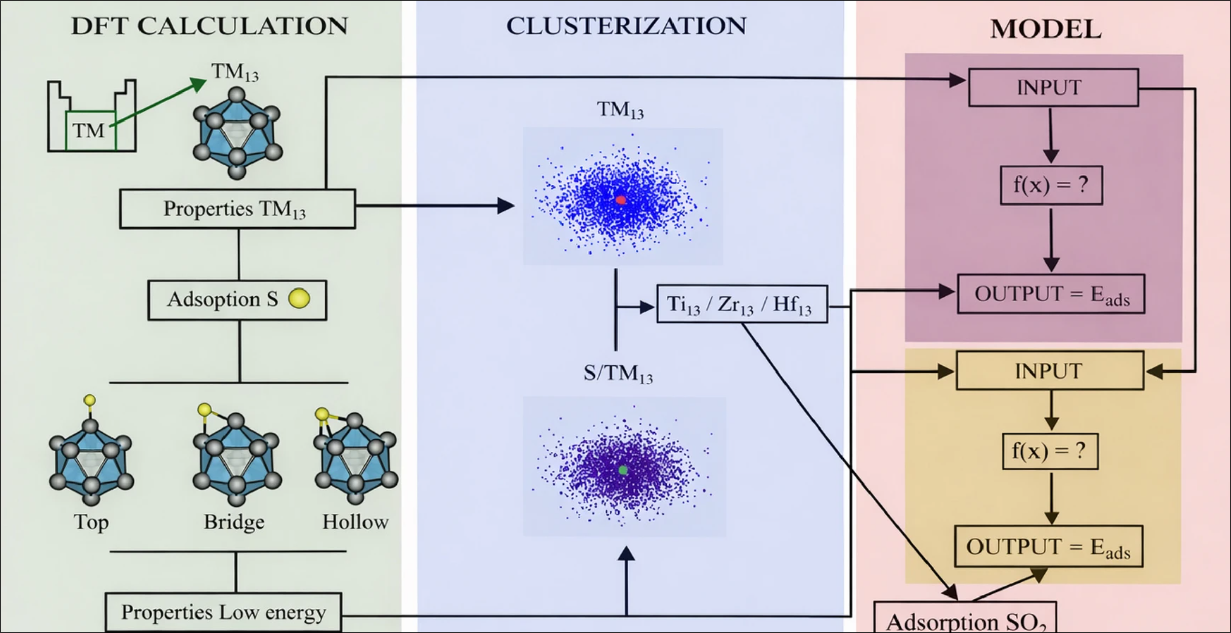
Transition-metal nanoclusters exhibit structural and electronic properties that depend on their size, often making them superior to bulk materials for heterogeneous catalysis. However, their performance can be limited by sulfur poisoning. Here, we use dispersion-corrected density functional theory (DFT) and physics-informed machine learning to map how atomic sulfur adsorbs and causes poisoning on 13-atom icosahedral clusters from 30 different transition metals (3d to 5d). We measure which sites sulfur prefers to adsorb to, the thermodynamics and energy breakdown, changes in structure, such as bond lengths and coordination, and electronic properties, such as , the HOMO-LUMO gap, and charge transfer. Vibrational analysis reveals true energy minima and provides ZPE-based descriptors that reflect the lattice stiffening upon sulfur adsorption. For most metals, the metal-sulfur interaction mainly determines adsorption energy. At the same time, distortion contributions are generally moderate, but become large in magnitude for a few metals, suggesting a stronger tendency toward adsorption-induced restructuring. Using unsupervised k-means clustering, we identify periodic trends and group metals based on their adsorption responses. Supervised regression models with leave-one-feature-out analysis identify the descriptors that best predict adsorption for new samples. Our results highlight the isoelectronic triad Ti, Zr, and Hf as a balanced group that stands out by combining moderate-to-strong sulfur binding with excellent structural stability. This combination suggests an optimal trade-off between the chemical activation of sulfur-containing species and resistance to poisoning-induced structural degradation. Additional DFT calculations for adsorption reveal strong binding and a clear tendency toward dissociation on these clusters, linking electronic states, lattice response, and poisoning strength. These findings offer data-driven guidelines for designing sulfur-tolerant nanocatalysts at the subnanometer scale.
Related Articles
No related articles found.